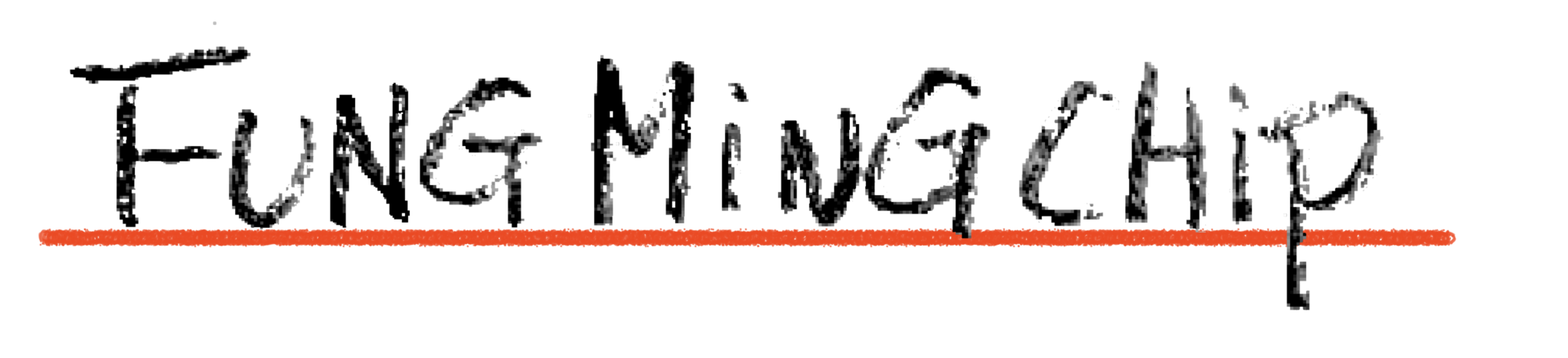

The Seals of Ming-Chip Fung

The Seals of Ming-Chip Fung by Wang Fangyu (Originally published in the brochure for the exhibition Ming-Chip Fung : The Seal 1975-1985, New York) 1986        Chinese seal carving is a special form of literary art which traditionally has served the dual function of decoration and identification of paintings and calligraphy. The art of seal carving is closely related to that of calligraphy, as illustrated by the following shared characteristics:        Most seal designs, like calligraphy, are arrangements of Chinese characters.        The characters used in seals form intelligible phrases or sentences.        The artistic worth of a seal carving is evaluated in terms of the lines, composition and vitality of the entire work.        As with calligraphy, the formats and forms of seals have changed little over the past two thousand years.        While seal carving is an outgrowth of calligraphy, it possesses a number of characteristics that set it apart from that art form: Seals traditionally have been used in association with painting or calligraphic works, while a piece of calligraphy can stand by itself as an independent art form. Characters used in seals are for the most part limited to ancient styles.  Works of calligraphy, in contrast,

Read Essay»

Moving through Time, Writing in Water: The Calligraphic Art of Fung Ming Chip

Valerie C. Doran While there are many levels of seeing and saying in Fung Ming-chip’s calligraphic art, there is one aspect  that is most fundamentally telling: that in many of these works, his first action is to write words in water. This action in itself sends out myriad waves of resonance across time and space. Dipping his brush in clear water, making gestural, codified movements across the surface of the absorbent xuan paper, he leaves marks that are at once strongly painted and literally evocative, both present and inherently absent; ephemeral in both space and time. Thinking of this brings to mind associations with the Chinese scholar-artists wandering in the mountains five hundred years ago, stopping to write calligraphy on the face of a mountain cliff, to be washed away by mist and rain. Or in another time and another world, to Andy Goldsworthy’s fragile land art, time-sensitive constructions engaging natural materials, ice or water, leaves or sand, that are then left behind to be interfered with, to mark the passage of time within the qualities of that particular space. The second action that Fung Ming-chip takes, is to change everything. Now dipping his brush in ink, he paints over

Read Essay»

THE IDEOGRAPHIC ART OF FUNG MING-CHIP

For centuries in China, countless artists and writers have used the brush in order to transmit their ideas. It is inconceivable that Chinese culture could exist without the brush. In an illuminating essay by Ezra Pound and Ernst Fenellosa, called “The Chinese Written Character as a Medium for Poetry” (1936), the careful distinction is made between the pictographic sign and the ideograph. The first type of character evolved much earlier than the second. A pictogram has a direct one-to-one correspondence with an object or event. On the other hand, the ideograph is a more complex sign that alludes to human feelings within the context of ideas. The ideograph is more cultivated and more refined than the pictogram. Modern Chinese calligraphy is based on writing the ideograph or, in some cases, on the interpretation that an artist brings to the ideograph. The first stroke of the brush by an artist is the essential one. It gives the indelible trace of the artist’s hand fused with a conceptual knowledge of time and space. The first stroke presents the quality and power of the artist’s ability to transmit meaning — not only in terms of what is written but in how the visual

Read Essay»

Ming-Chip Fung

The fine art of calligraphy plays an important role in our cultural life today. When I speak of our cultural life I am referring to the tactile intelligence of the brush as a vehicle for transmitting important human values. Ming-Chip Fung is an artist with a supreme gift.  He carries the tradition of this fine art. To make a mark on paper with the brush represents a point of transition. The mark or the stroke can go in two directions. It can represent a picture-language, but it can also represent a language-picture.  It can give us a message about who the artist is as a transmitter of an important cultural heritage. Ming-Chip is such an artist. By knowing the basics, he is capable of going in whatever direction he chooses. He can tell us something else with language. Ming-Chip Fung is an abstract artist, an advanced thinker with relation to art, who is bringing the art of calligraphy into the present-day.  He is an inventor of new ideas through language and picture. Robert C. Morgan Art Critic New York City December 1998

Read Essay»

Calligraphy After Postmodernism: The Art of Fung Ming-Chip

by Robert C. Morgan The art of calligraphy has a special meaning in China. In many ways, it is the basis of fine art. To write with the brush requires an acute degree of physical and mental concentration. Calligraphy is the writing of complex ideographic forms. It is a process that involves a direct engagement with both time and space. There are three basic concerns that the artist/calligrapher needs to understand: First, the manner in which the artist must attend to the constructed space within each sign; each linear element is essential to this construction. Secondly, the artist must attend to the relationship of the signs to one another; each ideographic form functions as a spatial unit in respect to the others. The pictorial space relies on the weight that is given to the other neighboring elements. Finally, the artist must see the pictorial space as a whole. In this way, the artist comprehends conceptually how the balance of the various signs coalesce as a single sign. Each ideograph is balanced in relation to the pictorial space, sometimes symmetrically, but oftentimes not. Fung Ming Chip, who opened with a major mid-career retrospective at the Taipei Fine Arts Museum on April

Read Essay»

Reordering Tradition By Hilary Binks

Looking at a tradition as rich and as diverse as Chinese calligraphy in a fresh and original way is an outstanding challenge to any artist. For two decades, Fung Ming-Chip has explored the myriad possibilities of the Chinese calligraphic form. While using traditional materials and remaining faithful to the literary aspects of the characters, he has developed a different set of writing styles to make beautiful and intriguing art. Calligraphy is one of the most ancient Chinese art forms. It is also one of the most highly esteemed. In the 8th century, an emperor of the Tang dy-nasty acclaimed calligraphy as one of the “three perfections” worthy of a gentleman scholar, the other two being poetry and painting. In his essay cata-logue for the exhibition Power of the Word curator Chang Tsong-zung points to the dominance of the written word as a deco-rative art form in China from ancient times.1 Calligraphic inscriptions were among the key elements of architectural decoration, while sacred mountains, historical sites, and important temples were inscribed with the calligraphy of emper-ors and illustrious scholars. Although the Communists introduced the icon-a figu-rative portrait of Mao Zedong-to empha-size their authority, Mao’s calligraphy, too, became predominant and is still

Read Essay»

THE BEGINNING OF INFINITY

Evolution generates its complexities. New techniques and thinking in art offer geometrically expanding potential combinations as they evolve. Infinity is a mathematical extension beyond the new and is a concept applicable to the psychological origins of art  – deemed, today, an infinitely complex regression and thus possessed of an unapproachable simplicity – as well as to the current wealth of combinations of the traditional and the new. All are waiting to be discovered; but looking back on each step, we ask ourselves why it had not been taken before. Our individual want of genius inclines us to label this or that evolution dramatic, remarkable, or revolutionary, but we still subsequently categorise it, making part of the history of artistic thinking. This is as it should be. If Nietzsche addressing the Spirit of Gravity is right and ‘all that can run has already run along this Lane ’ – and, seen from the gateway, Moment – ‘has been done, run past’,  then an infinity has gone before and passes after, and we are simply steps along the path. In this spirit, an artist such as Fung Ming Chip, who invents a wealth of new scripts, is adding infinitesimally but infinitely to

Read Essay»

REVELATION, REVOLUTION AND RESOLVE

For the past thirty years, Fung Ming Chip has developed and applied an artistic language which draws on wide ranging sources, to explore the roots of the calligraphic image: seal carving, wood carving, ink painting, as well as sculpture and sgraffito. Since, at the most obvious level, calligraphy is writing, and writing brings meaning, and meaning over time makes narrative, to approach a work by Fung is to be drawn into a textual, visual and intellectual story. The immediate story of these calligraphic texts is personal and contemporary as well as revealing. The visual impact of the story is given ‘simply’ by marks on paper. The intellectual story is dramatic – even revolutionary – and is a vital reflection of the transformation of Chinese art and society as China opens further at the start of the 21st Century. The fascination and the problem for Western viewers is that the narrative is not easy to understand, unless you can read Chinese. This same problem can be faced by Chinese and other Asian viewers – even artist sometimes has to refer to his carefully kept book of notes, which records the meaning of each of his scrolls and poems in case, at

Read Essay»

CHINESE TRADITION IN THE MODERN WORLD

Fung Ming Chip’s calligraphy opens the heart of Chinese culture to the modern world. His use of space, of light and dark and his extraordinary technique bring to life the poems he himself creates. This poetry discloses a contemplative, engaged and above all human artist. We apprehend the emotional content of the form, almost feel the meaning of the script, respond to the varying density of the ink and the brush strokes. Yet, while expressing modern notions in a revolutionary way, Fung’s artistic tools have remained true to traditional techniques. In this, Fung Ming Chip is unique among contemporary calligraphers. What does this imply for the interaction of ‘Chinese’ art with the world? Today, China’s hunger for the modern is mirrored in the pursuit of economic growth, the embrace of foreign architecture and unfettered enthusiasm for the Olympics. Chinese art also seems to look outward for inspiration. The early 20th century did not offer a very solid platform, but after 1979, things changed. First, the “Stars” group sparked a significant ‘liberation’ of the Chinese artistic spirit. This gave impetus to art with ‘sociological’ labels (Cynical Realism, Political Pop), in Western media. Then the 1990s diaspora of Chinese artists (in Germany,

Read Essay»

Ming Chip Fung’s art: From seal to relief work to bronze sculpture

Ming Chip Fung’s art: From seal to relief work to bronze sculpture by Nancy T. Lu The China Post December 1992           The lines, the strokes and the shapes that emerge from the imagination of artist Ming Chip Fung strike onlookers initially as resembling stick drawings seen in caves of primitive times.           But that is because the New York-based Fung strongly believes in making one clear art statement: Go back to the basics.  From his creative exercises in playing with words come art expressions filled with basic elements in Chinese characters.  For example, the sun, the moon, and the stars are represented in the most elementary outlines that bring to mind the beginnings of Chinese writing.           “People take a look at me and conclude that I am not likely to have a grasp of the traditional Chinese arts,” says the 41-year-old Fung.  “The truth is I started out by mastering something traditional for my basic background.  I am reverting back to the basics in my art.”           Fung took up traditional seal carving after watching a friend at work in Hong Kong.  He asked if he could try to carve a chop with the tools available and a

Read Essay»