Valerie C. Doran
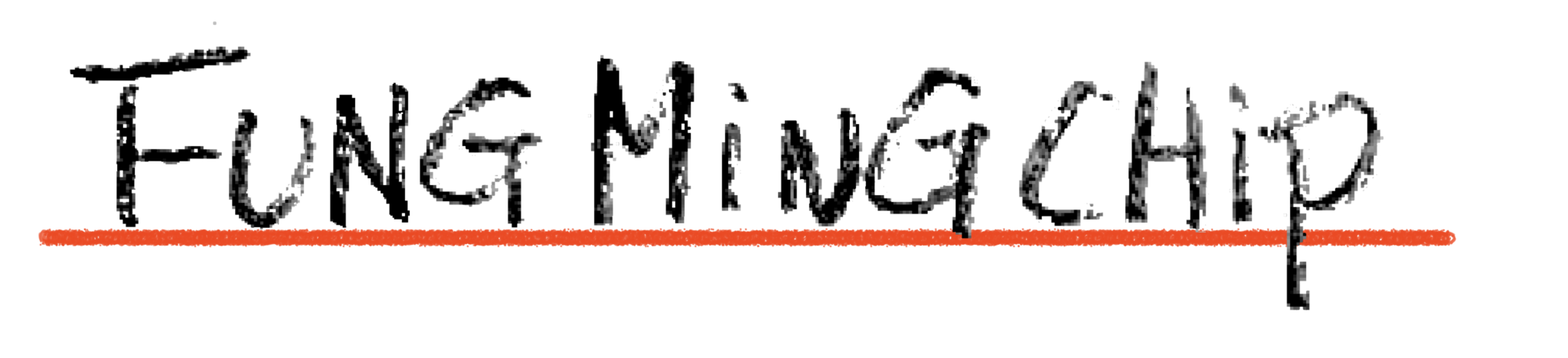
While there are many levels of seeing and saying in Fung Ming-chip’s calligraphic art, there is one aspect that is most fundamentally telling: that in many of these works, his first action is to write words in water.
This action in itself sends out myriad waves of resonance across time and space.
Dipping his brush in clear water, making gestural, codified movements across the surface of the absorbent xuan paper, he leaves marks that are at once strongly painted and literally evocative, both present and inherently absent; ephemeral in both space and time. Thinking of this brings to mind associations with the Chinese scholar-artists wandering in the mountains five hundred years ago, stopping to write calligraphy on the face of a mountain cliff, to be washed away by mist and rain. Or in another time and another world, to Andy Goldsworthy’s fragile land art, time-sensitive constructions engaging natural materials, ice or water, leaves or sand, that are then left behind to be interfered with, to mark the passage of time within the qualities of that particular space.
The second action that Fung Ming-chip takes, is to change everything. Now dipping his brush in ink, he paints over the water-writing, creating evocative configurations of ink. But rather than being hidden or erased, the marks shine subtly through the ink: traced in water, these word-images are yet ineradicable. As they glimmer through the ink-wash, they mark the passage of time by the re-emergence of their presence, rather than by their declension into absence.
Fung’s “water-writing” technique is the result of the artist’s own analysis of the further possibilities inherent in the special qualities of the absorbent paper used by Chinese calligraphers for centuries. As the artist himself explains, unlike in Western oil-on-canvas, where the first stroke is painted over by the second, the absorbency of xuan paper “blocks” the second layer of ink from eradicating the initial marks made in water, with the result that these marks (at once both semantic and semiotic) appear to float on top.
This is just one of many compelling results of Fung Ming Chip’s decades-long quest to extend the conceptual field of Chinese calligraphy, beginning with his initial work in the related art of seal-carving. Since the mid-1990s, Fung’s analysis of and re-engagement with the structure and materiality of calligraphy has led also to his creation of over one hundred new “script types,” a number of which are represented in the current exhibition: “scatter script,” “form script,” “light script,” “black on black script,” “bubble script,” “halo script,” to name a few. With these scripts, Fung sometimes deconstructs the spatial arrangement of Chinese characters, sometimes collapses it, sometimes re-focuses it. Throughout, the nucleus of his art-making has been an exploration of the possibilities for expanding or reshaping the time-and-space elements inherent in this unique art form that is at once visually progressive and literally narrative. (As Fung Ming Chip has written, “Text is a prerequisite for calligraphy, and the quality it imparts is time.” In his works, the text is usually one of his own poems.)
Perhaps the best place to conclude here is with a re-emphasis on the fact that this is precisely why Chinese calligraphy remains absolutely unique as an art form. And why as a consequence it represents a challenge both as a tradition and as a matrix for change. Chinese calligraphy represents the complete merging of word and Form. It is logographic without being logocentric. There is absolutely nothing like it in the aesthetic or conceptual vocabulary of Western culture. Certainly there have been interesting attempts by Western artists, both literary and visual, to create a visual text art: for example, the “Calligrams” of the surrealist Guillaume Apollinaire, the post-war Concrete Poetry movement and, more recently and far more compellingly, the text-based art of Jenny Holzer. Despite the vast divide in terms of materiality, in her method of merging narrative content and Form, Holzer perhaps comes closest to an essential element of Chinese calligraphy.
Going one step further, however, calligraphy encapsulates much more. Beyond the “literati sensibility” or the now-extinct literati lifestyle by which it is often so dismissively circumscribed in contemporary art circles, calligraphy in its very physicality represents an entire cosmological world-view (one only needs to refer to the writings and inscriptions of the iconoclastic 17th-century artist Shitao to taste this in full). That is why, in this post-modern world, for an artist like Fung Ming Chip (or even artists who have sought to negate or explode the word-form relationship, like Xu Bing or Wu Shanzhuan), the exploration and engagement with Chinese calligraphy is in fact a radical act, like Jacob wrestling with the angel. Fung Ming Chip’s importance lies not only in the compelling art he makes, but also in his awareness that creative breakthrough is not as much a question of revitalizing/challenging calligraphy but of revitalizing/challenging one’s understanding of it.