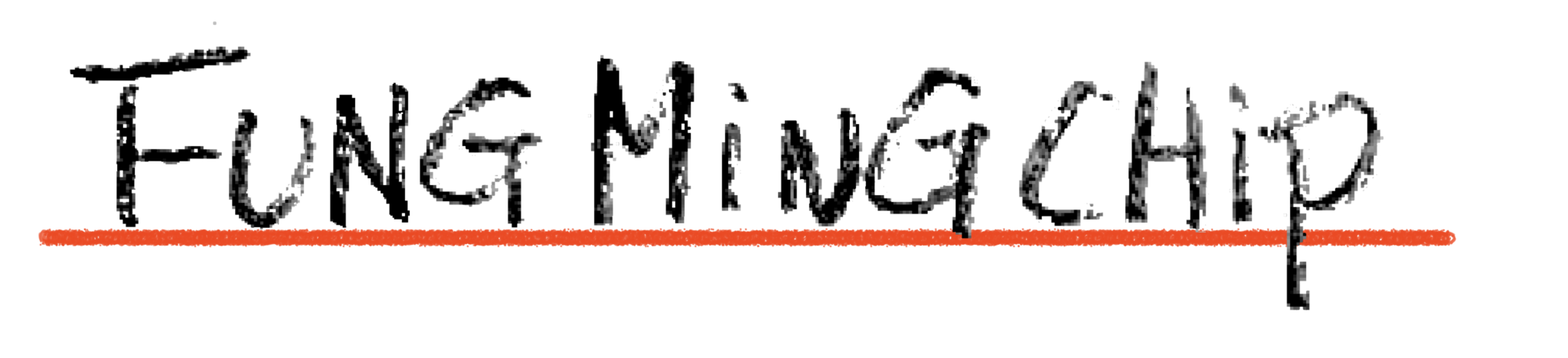
Fung Ming Chip’s calligraphy opens the heart of Chinese culture to the modern world. His use of space, of light and dark and his extraordinary technique bring to life the poems he himself creates. This poetry discloses a contemplative, engaged and above all human artist. We apprehend the emotional content of the form, almost feel the meaning of the script, respond to the varying density of the ink and the brush strokes. Yet, while expressing modern notions in a revolutionary way, Fung’s artistic tools have remained true to traditional techniques. In this, Fung Ming Chip is unique among contemporary calligraphers. What does this imply for the interaction of ‘Chinese’ art with the world?
Today, China’s hunger for the modern is mirrored in the pursuit of economic growth, the embrace of foreign architecture and unfettered enthusiasm for the Olympics. Chinese art also seems to look outward for inspiration. The early 20th century did not offer a very solid platform, but after 1979, things changed. First, the “Stars” group sparked a significant ‘liberation’ of the Chinese artistic spirit. This gave impetus to art with ‘sociological’ labels (Cynical Realism, Political Pop), in Western media. Then the 1990s diaspora of Chinese artists (in Germany, Japan, the USA) assimilated foreign ways and integrated Chinese art into the international art world. Today, contemporary Chinese art shows a distinctive energy in installation art, video and photography.
These successes are evaluated on “Western” terms, and in a Western critical framework. Johnson Chang has commented that modern Chinese art will come of age only when evaluated in Chinese terms, and the global ‘value’ of a piece is determined in Beijing, not Paris, London or New York. Critic Gao Minglu seeks to redefine the critical framework. In a recent essay on ‘Chinese Maximalism’, he nominates as characteristically Chinese: concern for ‘process’, a tendency towards ‘replication’ and ‘arbitrariness’, love of ‘movement’. He also identifies a desire for social context and the subservience of form to inner substance. Each of these was vital to the Modern movement: arbitrariness and chance guiding the Tachists (Michaaux, Bissier); preference for inner form over substance motivating Klee and Kandinsky; ‘movement’ inspiring gestural art (Kline, Motherwell, Pollock).
China’s most deeply imbedded art values are thus fully up to the task of guiding critical evaluation in modern art. And calligraphy, which fuses form and meaning, spirit and expression, language and picture, action and poetry, and uses ink, rice paper and brush, quintessentially Chinese tools, is therefore the perfect arena in which to develop a new reference-framework for modern art criticism.
Today, we seek to understand calligraphic work through familiar categories. First, we observe the overall structure, perhaps attribute to it an abstract significance. Then, we consider physical qualities – the interaction and layering of the strokes and the space around them, the density and tone of the ink. Finally, if we read Chinese, we understand in the literal as well as the aesthetic sense. Fung’s works hit us at three levels: the structure (influenced by the choice of script); the technical execution of the calligraphy; and the poetic content. In each area Fung’s work reinforces the new critical framework.
Not reading Chinese is no deterrent to grasping Fung’s calligraphy: one need not speak Chinese to absorb the gestural and emotional content, and it needs little study to appreciate the most important elements of Fung’s technique – no more than to appreciate the symbolism of Klee, the visual expressiveness of Motherwell, or the layering or luminosity of Rothko. Literal meaning is less accessible: but even Fung refers to his book of poems to recall their exact meaning.
Each visually distinct element of his work – ink, seal, space, gesture – generates individual emotional content, capturing the viewer’s eye, even before the technical means are appreciated or the literal meaning construed. Visually, the most intriguing of Fung’s scripts is arguably his light script, as in ‘Right and Wrong’, in which dark layers establish the base and light appears to well up through the dark; by contrast, music script is more playful, and the allusion to musical notation generates curiosity even before one knows the title: ‘Landscape’. Such is the adaptability of Fung’s calligraphic language that a single brush stroke can illuminate, like a candle flame, the thinnest layer of watery ink that lies on the surface of ‘Night’, pale and almost invisible; while in ‘Long Distance Love’ the dark turbulence of the lower half of the painting, coupled with the wild dry brushstrokes that escape into the upper part of the work, vividly expresses the feelings of the poem.
Ming’s seals are not merely traditional. Their sharp red forms enhance the tones of his ink, set off the extremes of black or white. In ‘Each Other’, the seal creates a focal point in the ‘empty’ space containing his transparent script (palest ink, or water on white paper)’, while in ‘Long Distance Love’ it forms a line of symmetry lifting the eye through the turbulence to the sky.
Whether our first impression is of gentleness or mystery, energy or power, we want to know how Fung creates these effects. The list of scripts he has invented is long. The early ones play with space and the structure of the ideograph. Scatter script breaks apart the ideograph, opening its interior, scattering the strokes in space; in pile or grass script, the strokes pile together, eliminating exterior space between the ideographs; in form script, the edges soften and create a gentle, anthropomorphic effect. These scripts illustrate the inner structure of calligraphy without violating the individual elements of the ideograph, only their relationships.
The scripts illustrated here highlight two other aspects of calligraphy: layering and timing. The layers of ink interact such that the first layer is dominant: when Fung writes in extremely pale ink, or even water, that image persists through darker ink painted over it, which is rejected by the first layer, already absorbed into the paper. That gives his ‘Light’ script its luminosity and depth (‘Right and Wrong’). It also permits word play. ‘Naivete is Power’ uses secret script, with ‘power’ written first in paler ink, and despite looking weaker, overrides the word ‘naivete’ written later, in darker ink – a conundrum worthy of the work’s title.
Seeing layers enables one to see the timing of strokes, a major contrast to our experience of oils – which you generally cannot see through – and to Western gestural, abstract or calligraphic work. No element of timing is evident in Motherwell, Kline or Soulages, but it is clear in Fung’s work. This notion of timing, of a process recorded in the work, reinforces Gao Minglu’s perception of a characteristically ‘Chinese’ mechanism. Calligraphy becomes a succession of connected moments, whose temporal relationship is simultaneously visible – a form of instant video.
Awareness of timing allows subversion of tradition by executing strokes in the wrong order, or writing a poem backwards in time, though the physical order of the ideographs remains traditional: right/top to bottom/left. In ‘Man and Woman’, Fung uses reverse time script to remind us that relations between the sexes are not what they appear, that cause and effect are not easily separated.
His art stirs other echoes: the long-established appeal of Zen, and the use of chance. In ‘Each Other’, his transfer script uses ink-moistened glass to create pale ‘ink bubbles’ in which transparent script is clearly revealed, while the untouched ideographs shimmer softly, scarcely visible. Instead of water and glass, Fung may blow dried ink over water-painted calligraphy – ‘Sand’ script – to bring words to life through the accidental attachment of grains of ink powder to the moistened surface. A similar effect comes from lightly brushing dry ink over damp ideographs, (‘Long Distance Love’).
The tones of Ming’s ink even communicate colour, our guide to emotion. Firm blacks, pale creamy greys, greenish mid grays and slate-blue ink strokes bring great subtlety of expression, imbuing each work with the emotional complement to its content. ‘Wave’ sets a hard, reflective black against a paler black background on one half of the work, which, combined with shadow script on the other side, mutates into a soft, gentle grey.
If the range of Fung’s styles, and his technical subversion of tradition make him a properly Chinese ‘modern’, his choice of texts makes him contemporary. Since living in New York as a young artist he has expressed real life through his poems – from sex to the spiritual, from drugs to flying high in planes. “The Story Of Sperm”, “Song Of The Night Walker”, “Post-Marijuana”, “Wave” (sexual release) are titles which uninhibitedly express contemporary experience, as ‘Each Other’, Loss of Love’, ’Naivete is Power’ express the universal human condition.
He brings into the outwardly traditional world of calligraphy not the refined isolation of the gentleman-scholar, but real experience, applicable to 21st century China. In this, Fung’s presentation is in tune with a world in which art must reflect real life. And his calligraphy, with its capacity to express time, its breaking down of traditional barriers, is uniquely in line with a world in which the video image has overtaken the printed word as the prime communicator for our times.