
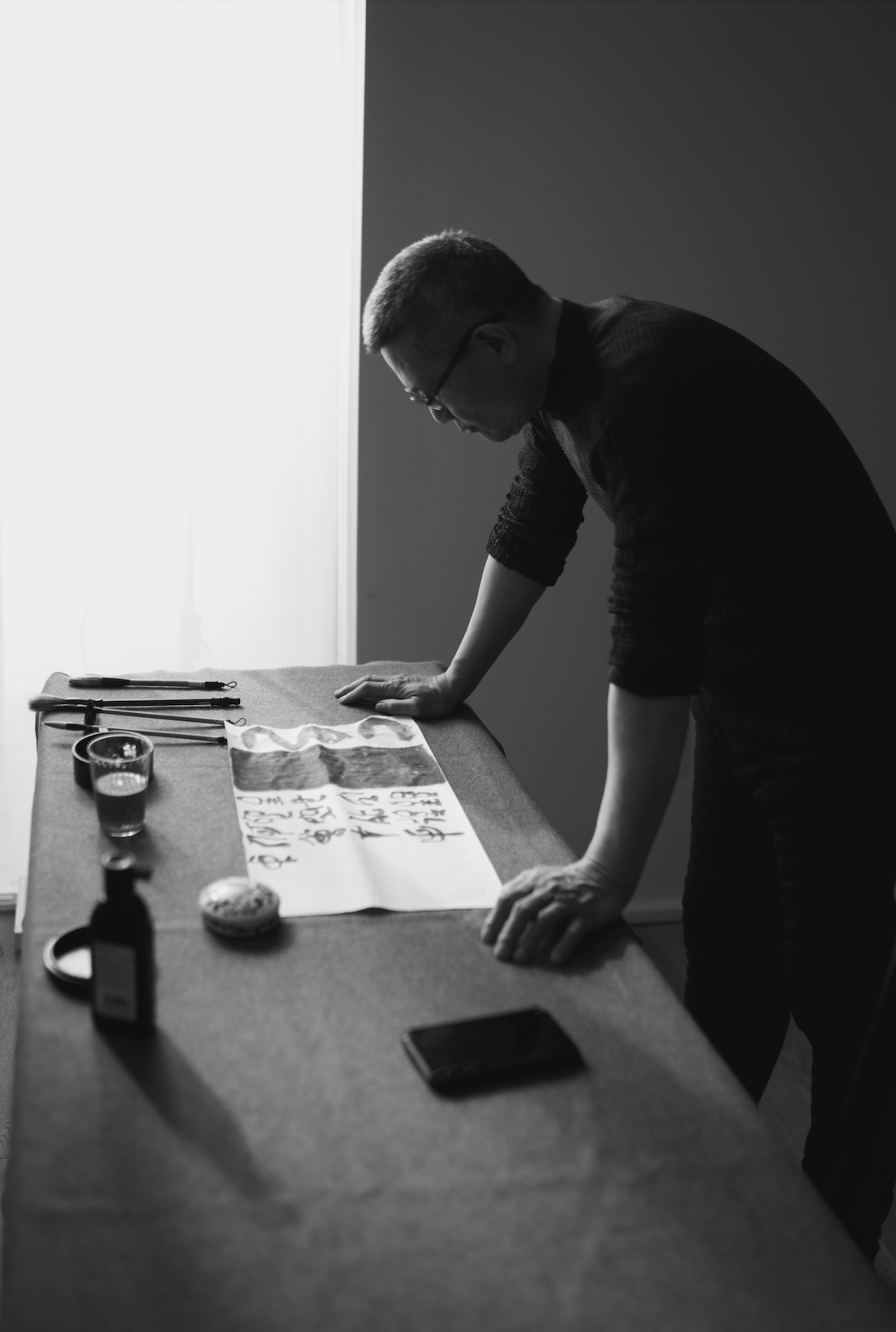
Fung Ming-Chip moved to Hong Kong in 1956 where he completed his primary school education and began to work. In 1977 he moved to New York where he was exposed to and inspired by the Manhattan art scene. Since then, he has returned to China to continue his calligraphic art practice.
Fung Ming-Chip’s artistic process is akin to scientific research, particularly to that of pathologists who raise influenza virus cultures in their laboratories to create vaccines: these researchers are so deeply familiar with the variables of the viruses that they are able to predict the conditions leading to the next strain, and to develop new vaccines to meet those conditions. What Fung Ming-Chip cultivates in his studio is new strains of calligraphy, rather than viruses.
Through his own unique process of research and analysis, Fung Ming-Chip draws out new inferences on both a technical and conceptual level, leading him to new discoveries. To date, he has developed over 140 new strains (artworks). Positing and predicting new classifications in calligraphic development, Fung undertakes experiments to determine the feasibilities and possibilities inherent within each one. In this way he not only extends the tradition of calligraphy, but also expands its development as a contemporary art form.
Fung Ming Chip’s work has been exhibited internationally including The Metropolitan Museum of Art, Rietberg Museum, Museum of East Asian Art, Los Angeles County Museum of Art , etc. His work is included in the permanent collections of The Metropolitan Museum of Art, Brooklyn Museum, Princeton University Museum, Asian Art Museum San Francisco, Harvard University Museum, Ashmolean Museum, Oxford University, White Rabbit Gallery, Jerusalem Museum, and the Hong Kong Museum of Art.
馮明傑於1956年移居香港,完成小學教育後開始工作。 1977年,他移居紐約,接觸並深受曼哈頓藝術圈的啟發。此後,
馮明傑的藝術創作過程類似於科學研究,
馮明傑透過獨特的研究和分析,在技術和概念層面得出新的推論,
馮明籌的作品曾在國際上展出,包括大都會藝術博物館、