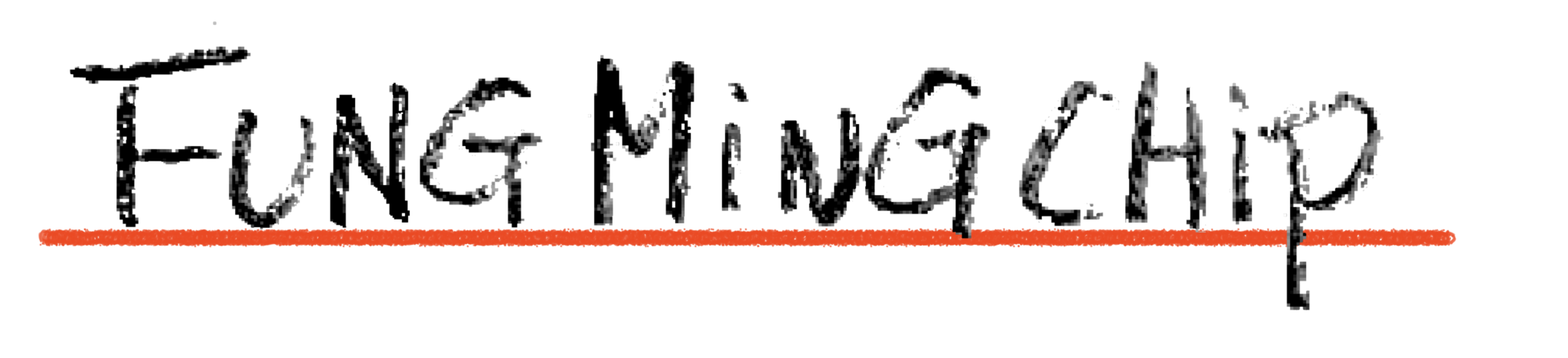
by Robert C. Morgan
The art of calligraphy has a special meaning in China. In many ways, it is the basis of fine art. To write with the brush requires an acute degree of physical and mental concentration. Calligraphy is the writing of complex ideographic forms. It is a process that involves a direct engagement with both time and space. There are three basic concerns that the artist/calligrapher needs to understand: First, the manner in which the artist must attend to the constructed space within each sign; each linear element is essential to this construction. Secondly, the artist must attend to the relationship of the signs to one another; each ideographic form functions as a spatial unit in respect to the others. The pictorial space relies on the weight that is given to the other neighboring elements. Finally, the artist must see the pictorial space as a whole. In this way, the artist comprehends conceptually how the balance of the various signs coalesce as a single sign. Each ideograph is balanced in relation to the pictorial space, sometimes symmetrically, but oftentimes not.
Fung Ming Chip, who opened with a major mid-career retrospective at the Taipei Fine Arts Museum on April 24, has been working with the brush for most of his life. Since 1986 he has divided his time between Taipei, Hong Kong, and New York. His art has moved between the art of writing and other related forms of visual art. In the early nineties, Ming began investigating the seals used by the literati in designating standards of quality in relation to the best calligraphy. These seals — often called “chops” — were originally carved in stone. By using a reddish dye, these seals were applied to works of calligraphic art; thus, giving certain works an important status throughout the various dynasties. Ming invented a series of seals incorporating “non-words”; that is, made-up pictographic elements that suggest but never actually depict a word. Ming’s seals are presented on a long folded scroll as isolated elements within an empty space.
More than significant, this emptiness constitutes a poignant aspect of the work, holding forth an expressive contiguity. This is a rare quality that one does not usually associate with these seals. But it is the placement of the seals within the pictorial space that gives these encapsulated ideographic signs their energy and importance. Without the sense of spatial-ity, the seals would simply float without an intention, without a sense of purpose.
For the past several years Ming has worked in several directions simultaneously. After the stone-carved seals, he began to enlarge the seals and to carve them in the form of sculptural reliefs. Many of these were exhibited in the Taipei Museum. One might see these works as a form of Chinese Pop Art. Using the comparative example of Roy Lichtenstein, rather than the comic book separation between the image and the caption or bubble, Ming brings together the image/text as a single pictographic unit (historically predating the evolution of the ideograph in China). Many of these symbolic forms are whimsical, erotic, and absurdly humorous in their content.
Ming has also extended some of these relief forms, as they began to emerge from the stone-carved seals, into bronze sculpture. In addition, Ming has used them decoratively in relation to the design of glass screens. But the most important aspect of his current practice is within the art of calligraphy. It is here that Ming has excelled. This is the foundation of everything else. Thus far he has invented over fifty new calligraphic scripts. Like his colleague Xu Bing, Ming has pushed the envelope of calligraphic art outside of the once-sacrosanct tradition of the academy into a more open, even playful form of writing. Yet, at the same time, there is a serious aspect to his calligraphy.
In calligraphy, the manner in which an ideograph is created — whether carved or written — is considered as important as the literary meaning that is being expressed. In modern calligraphy, as the curator and scholar Yiguo Zhang has made clear, the visual means of representation often outweighs the literary content.
Zhang claims that “modern calligraphy belongs to modern life and a modern appreciation of art.” Whereas in the tradi-tion of the ideograph, both visual and literary expressions ultimately come together, modern calligraphy often forsakes the literary component entirely in order to focus on the energy of the mark as an implicit expression of the artist’s feel-ing. The literary concept is therefore sublimated and is therefore more bound to the inventiveness of the artist’s visual acuity and thought process. In modern calligraphy, the subtle intricacies of how the brush is applied to the paper and the variations by which the different lines constitute the shape and stylistic expressiveness of the ideograph are paramount. Even though the characters have literary meaning, the meaning is only a conceptual armature in order to enable the cal-ligrapher’s style to flourish.
Several years ago, Fung Ming Chip became fascinated while observing a hand-scroll by Mi Fu (1051-1107) at the Metropolitan Museum of Art in New York. Ming saw it as a revelation: “The tremendous variation in line was proof that he used the brush in a million different ways, his hand following every thought, exploiting every part of the brush and every technique.” This was a turning-point in the artist’s career. It was also a challenge. Ming realized at this juncture that calligraphy had to move beyond its tradition in order to find a synthesis with other contemporary art issues that were entering into the globalized arena of advanced art.
While spatial orientation has always been essential in calligraphy, Ming will emphasize the entire spatial field in con-trast to the single modular space of the ideograph. His approach is directed to the spatial relationship between the indi-vidual units, seemingly giving less emphasis to the formal coherence within the separate ideographic units. For exam-ple, his series “Shadow Script” is a balance of both the strokes within each spatial unit and the larger spatial context that surrounds them. The page is presented in a subtle, yet distinct manner. The eye searches for the coherence and dis-covers a pattern. In another series called “Light Form Script”, Ming emphasizes only the larger spatial context, thereby leaving the individual spatial units as an absence, a grid floating in its own mysterious world — a world of writing that is perhaps more literal than literary. One work, called Buddhist Heart Scripture, was done in this style. One can view the traces of ideographs representing the scripture that were brushed in water. Over the water-brushed calligraphy, Ming has applied black ink. The ink on top reveals clearly the traces of the text that resides beneath.
In addition, Ming has worked with the “Scatter Needle Script” that resembles scattered pine needles in the wind. Here the ideographs are broken apart and the space fills the absence. Conceptually the viewer’s mind must reconstruct the broken signs to obtain their meaning.
It works like a deconstructive form of archaeology. As the artist explained: “The awareness of the stroke sequence makes the importance of space predominate over that of line.” In the “Time Script” series, the artist builds on top of former ideographs creating a deliberate congestion in the space, thus gain drawing attention to the over-all sense of the space, thus disseminating the meaning of the original text, substituting the literal manipulation of the brush — the conceptual energy for the subsumed significance. In the Taipei Museum exhibition, Ming has transposed the concept of traditional calligraphy into a sophisticated postmodern deferral of meaning. It becomes clear that Fung Ming Chip is on the cutting-edge of an age-old tradition, trying to re-make that tradition into a living art, instilling new significance into the historical basis of writing. He is writing over writing, in the sense of the postmodern palimpsest, making it happen as if it was being inscribed behind, rather than before our eyes.
NYArts