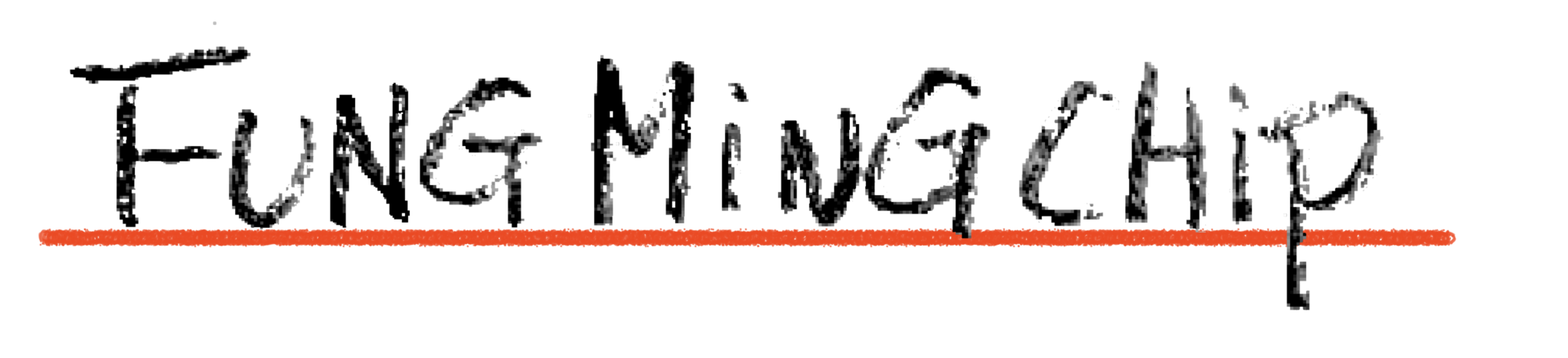
Looking at a tradition as rich and as diverse as Chinese calligraphy in a fresh and original way is an outstanding challenge to any artist. For two decades, Fung Ming-Chip has explored the myriad possibilities of the Chinese calligraphic form. While using traditional materials and remaining faithful to the literary aspects of the characters, he has developed a different set of writing styles to make beautiful and intriguing art.
Calligraphy is one of the most ancient Chinese art forms. It is also one of the most highly esteemed. In the 8th century, an emperor of the Tang dy-nasty acclaimed calligraphy as one of the “three perfections” worthy of a gentleman scholar, the other two being poetry and painting. In his essay cata-logue for the exhibition Power of the Word curator Chang Tsong-zung points to the dominance of the written word as a deco-rative art form in China from ancient times.1 Calligraphic inscriptions were among the key elements of architectural decoration, while sacred mountains, historical sites, and important temples were inscribed with the calligraphy of emper-ors and illustrious scholars. Although the Communists introduced the icon-a figu-rative portrait of Mao Zedong-to empha-size their authority, Mao’s calligraphy, too, became predominant and is still seen in the logos of leading institutions and news-papers today.
But if calligraphy has retained an important role until the present day, it is also one of the fields of Chinese art most tightly bound by traditional principles. The reading of calligraphy is intended to be both a visual and a literary experience, since unlike painting, it has a function; it is meant to be read as a text. It is read in a pre-determined way, from top right down the lines of characters to bottom left. Within a single word, too, there is a writ-ing order, from top left to bottom right. Faced with such apparent rigidity in calligraphy, how might an artist in the 21st century redefine this art form in a valid contemporary way? Numerous attempts to create a modern art form from calligraphy have failed because they have focused solely on graphic considerations. Born in Guangdong in 1951 and raised in Hong Kong, Fung Ming-Chip has taken a much more subtle and sensitive approach to the challenge.
Fung’s fascination with the art of the written word began with seal-carving, which he began practicing in 1975, before emigrating to New York in 1977. By 1983, after a period of upheaval in his life, he felt confident that he could elevate seal-carving to an independent art form. The late scholar Wang Fangyu explained that the art of seal carving is closely related to that of calligraphy in that most seal designs, like calligraphy, are arrangements of Chinese characters forming intelligible phrases.2 In both cases the artist’s work is judged in terms of the line, composition, and vitality of the whole work. On the other hand, seals, produced by carving stone, jade, or ivory, were traditionally used as marks of ownership on paintings, while a piece of calligraphy produced with brush and ink on paper or silk could stand by itself as an independent art form. Fung first deepened his understanding of traditional seal carv-ing by emulating the 19th-century master Huang Shi-ling, then later challenged the past by breaking the frame of the seal. In addition, he separated the Chinese characters from their literary quality, focusing on their primitive function as picto-graphs which he reduced to a level of abstraction in the interests of good composition and visual appeal. Later, he developed this idea further, moving from the miniature seal carved in stone to large-scale relief works in wood (still keeping the red, white, and black palette of tradi-tional seal carving), and finally to free-standing, three-dimensional sculptures in bronze.
These early experi-ments now seem a natural precursor to Fung’s artistic explo-ration of the art of calligraphy. His calli-graphic works are executed using the traditional materials of brushes, ink (ready-made Japanese ink from a bottle rather than an ink stone), and rice paper. They also remain faithful to the traditional idea that Chinese characters are inseparable from their literary meaning: they are based on written words, most com-monly his own poems or Buddhist sutras. In almost every other aspect, however, his works represent a departure from traditional calligraphy. Abandoning all but one-“running script” (caoshu) of the traditional six or seven traditional scripts, he has developed a whole vocabulary of new scripts of his own: Bamboo, Pine Needle, Swirl, Grass, Shadow, Sand, Zone, Light Line, Section, Rubbing, Straight Line Scatter, and Willow Script are just some of his innovations. Most importantly, he proposes how a text may be “read” in an entirely original way.
Fung is concerned above all with notions of time and space in calligraphy. Taking space first, normally one reads calligraphy from one’s viewpoint only, following the rules outlined above. But in Face to Face Hand Scroll “It Was” & “Wave,” Fung challenges this convention: one poem is read from one side, while alternating lines of the second poem are read from the opposite side. The two poems are differentiated by lighter and darker tones of ink. Border Script – “Sound Seeing, “meanwhile, breaks traditional rules of calligraphy by having the lines of writing pushed to the two side bor-ders, with a white space in the middle where a series of red seals take the dominant position normally given to the characters.
In Zone Script A, B- “Acciden-tally Passing, “the work is divided into two different areas: traditional callig-raphy on the right, one of Fung’s new scripts on the left. The poem contin-ues from one zone into the next. “My purpose is to create different kinds of space,” says Fung, “because tradition-ally the order and spacing is set by rules, without any real variation. Some-times I exaggerate the exploration of space further. In Bold Black Script -“Night, “there is no regular spacing between the characters, while in Half Script “Yellow Wen Ton,” I have cut the characters in half.”
F ung also sees time as a crucial element. Not only does each work of callig-raphy have a beginning, a middle and an end, but the order of construction of each character, created by the mov-ing brush, can be seen by the devel-opment from wet to dry ink. By exploring the qualities of his materials, especially the different tonalities produced by a greater or lesser dilution of the ink and the absorbency of the rice paper, Fung is able to emphasize this idea of a time sequence.
“Once a brush stroke occupies a space,” he says, “a second brushstroke cannot cover it. The first one will always show through, so you can tell which stroke is the first and which is the second. You can’t make changes later, so if there is something wrong, you have to throw away the paper and start again. When I started five years ago, my average success rate was one in 25. But it’s very important to maintain a high quality.”
Form and content are closely associated in Fung’s work as he chooses the most appropriate script for the poem he is writing, whether the subject is love or nature and landscape, or more modern themes like commu-nications. The overall composition, too, echoes the form of the original verse. Post Marijuana, written in Light Line Script to convey the right mood, is a triptych. It is a poem with three stanzas, so there is one panel for each stanza. Fung began by writing the characters in water, then putting the dark ink over the top on the right and left panels. The triangle, circle, and square shapes in the center of the three panels, which some may see as mere graphic forms, are in fact a reference to 19th-century Japanese calligraphy.
Wave is written in Sand Script, with very dry brush strokes. “Here you can see that the strokes of the callig-raphy are very expressive, maybe because this poem is about masturba-tion,” says Fung. “However, you can’t just reserve one script for one subject area. For example, I also use Sand Script for a poem on a totally different subject, Buddhist Heart Sutra. Here the line is very subtle. I used water first to write the characters, then put very dry, light ink over the top.”
Even to the non-Chinese reader, it is clear that the script in Wave creates a mood of turbulence, whereas the same script used quite differently in Buddhist Heart Sutra evokes a feeling of meditative calm. In the lat-ter work, Fung achieves a spatial depth and an ethereal quality suited to the subject. “I am always thinking about an aesthetic composition, as well as the meaning and visual im-pact of the individual characters,” says Fung. “I must, therefore, have an idea of the composition in my mind at the outset, though once I begin to write, it is spontaneous. I call it ‘predict-able spontaneity.”
Several works describe a progression, such as Material Number 747, written in Sequence Mounting. In this four-stanza work, Fung aims to create a sense of movement, as though the dark ink is falling down. The smaller panel at the top is the title of the poem. In the four other panels, the band of dark ink becomes increas-ingly broad as they descend. One pos-sible inference could be that the mood becomes more melancholy as the poem progresses, though as with all of Fung’s work, every kind of interpretation is possible. Fung describes his method: “The way I do the writing is very traditional, in order, in the cor-rect time sequence. So because of the composition, I had to change brushes on each line, from light to dark and back again. But as well as observing the time rule, my concern was also to make the work visually strong: the position of the red seals in each sec-tion emphasizes the progression of the dark ink.”
Chang Tsong-zung, curatorial director of Hanart TZ Gallery, who has shown Fung’s work since 1990, explains that, as with any visual art, dif-ferent levels of appreciation are pos-sible. “To start with, you get one overall impact from the whole pictorial sur-face, the mood and feeling of the piece. Then, when you want to read it more closely, it’s like when you look at a land-scape, or a figurative portrait; you look at the eyes, nose, mouth, the components, often guided by the way the painter has structured the painting,” says Chang. “Very often with Fung’s works, I don’t bother to read the content. But when I do, then it’s more interesting because you can com-pare the way one line links with the next line, or one stroke links with the next stroke, with an-other of his works. It becomes a much finer, closer reading. And, of course, if the text and the mood of the brush-work itself come to-gether nicely, it’s more satisfying.
“That kind of reading assumes the reader has used the brush himself. Tradition-ally, calligraphy was writ-ten for other practitioners of the art. There was this built-in mechanism of understood techniques and references. At a deeper level, a reader would recognize the in-fluence of a certain mas-ter calligrapher’s style, and that the writer chose this particular calligra-pher because of an incli-nation of his own personality. At the end of the day, the content of calligraphy is really your personal cultivation, not the message in the text. That is why sometimes the message, and the way it is written, can be completely reinterpreted in terms of the response of the audience, because the artist is writing under the influence of different moods. So looking for a strict correspondence between the content of the text and the type of expression can be slippery to grasp.”
While most people associate calligraphy with Chinese paint-ing, Fung believes it is closer as an art form to music or dance, and that the rhythm of a work is essential to its success. “Although each line is a flat surface, two-dimensional, the brushstrokes on the paper are the result of a three-dimensional movement of the brush. You move it up and down, in the -four directions, and you also twist it. Different movements of the brush result in different strokes, just as the work of a choreographer results in different body movements of the dancers. When you – look at a line of characters, you know how the brush moved, just like looking at the whole dance.”
Like any calligrapher, Fung draws inspiration from the old masters, but from their spirit rather than their tech-nique. For example, he takes the example of Zhang Yu (1277-1384) who used very unusual, even very undesirable forms of calligraphy in his time. “He is just bor-rowing the different structural games that people have played before,” says Chang Tsong-zung. “People wrote on many different shapes-round fans, folding fans, lattice work for win-dows for a long time. Word play is an old game. But the interesting thing about Fung is that he reflects in a fresh way on things that have been taken for granted. His work makes people think about calligraphy again and opens up new avenues. Writing on a two-dimensional surface can be just graphic de-sign. But how deep that structural design goes is the important thing. And whether one can make the rules transparent, or create rules which will make the game more intellectually interest-ing.” It is this original way of looking at calligraphy today that makes Fung’s work so intriguing, because he breaks all the rules in such a sophisticated and beautiful way. Δ
Notes:
1. Power of the Word, a traveling exhibition organized and circulated by Independent Cura-tors International (ICI), New York, 1999-2002.
2. The Seals of Fung Ming-Chip, catalogue of Fung Ming-Chip Solo Exhibi-tion, Taipei Fine Art Museum, 1999.
Hilary Binks is the Hong Kong contributing editor of Asian Art News and World Sculpture News.