Evolution generates its complexities. New techniques and thinking in art offer geometrically expanding potential combinations as they evolve. Infinity is a mathematical extension beyond the new and is a concept applicable to the psychological origins of art – deemed, today, an infinitely complex regression and thus possessed of an unapproachable simplicity – as well as to the current wealth of combinations of the traditional and the new. All are waiting to be discovered; but looking back on each step, we ask ourselves why it had not been taken before. Our individual want of genius inclines us to label this or that evolution dramatic, remarkable, or revolutionary, but we still subsequently categorise it, making part of the history of artistic thinking.
This is as it should be. If Nietzsche addressing the Spirit of Gravity is right and ‘all that can run has already run along this Lane ’ – and, seen from the gateway, Moment – ‘has been done, run past’, then an infinity has gone before and passes after, and we are simply steps along the path.
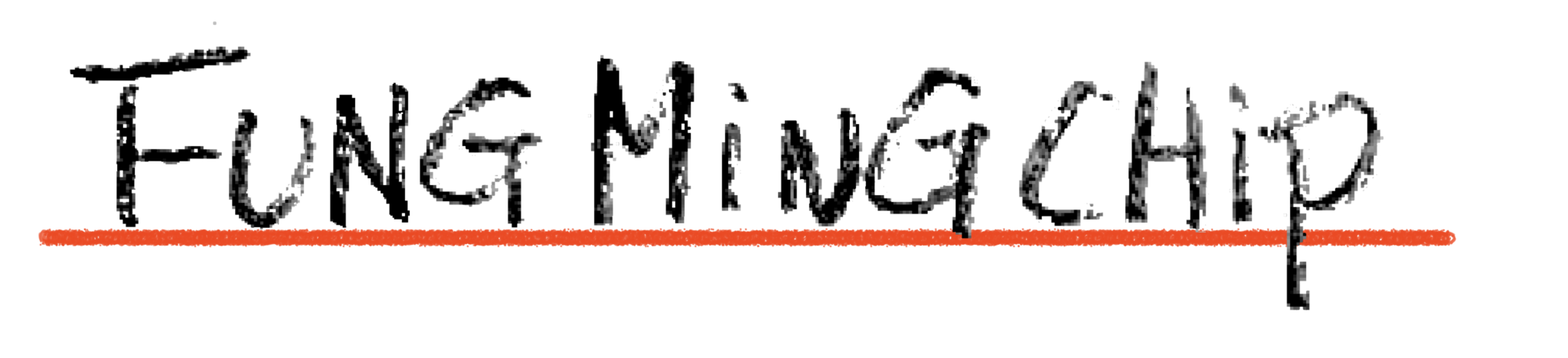
In this spirit, an artist such as Fung Ming Chip, who invents a wealth of new scripts, is adding infinitesimally but infinitely to the means of expression for future artists. The present exhibition offers the opportunity to review the way he has taken.
Traditional Chinese art involves six basic styles of calligraphic script. History evolved a number of recognised techniques. Now Fung Ming Chip has added scripts, generated new social cross-references, and made transparent (that icon of our age!) the way in which layers of ink interact.
Born in China, he started as an oil painter in New York – somewhat anguished, but highly expressive – before locking onto his fate and carving images on wood or into stone, primitive in origin, reminiscent of Klee or Kandinsky but, without Euro-centrism, going deep into the origins of the Chinese language and using elemental forms – moon, sun, stars, lightning, mountains and what we might self-centredly call ‘Lowry-Michaux’ figures – to portray the world he had absorbed into his heart. These early works are not much reviewed, compared to his calligraphy, but bear the same relationship to Chinese art as the early Modernists, in their return to elementary forms, bear to Western European modernism.
Fung, in his turn, matters to the history of Chinese painting, as well as to the use of the image in art worldwide, because the new scripts he has invented add to our ways of thinking about the interaction of image and meaning – one of the unique contributions of Chinese art to world culture, inherent in calligraphy’s unity of form and meaning.
When he uses his extremely pale, almost non-existent inks in ‘Transparent’ script we feel them as a shimmering presence on the surface of the paper, the perfect emotional counterpoint to the ‘letting go’ prescribed by the Buddhist sutras he sets down. And yet his sutras can do the reverse, and shine through the dark ink, illuminated from within by eternal light (‘Light’ script), as a lotus emerges from the mud.
This ‘Light’ calligraphic script emerges from the depths of swirling dark ink, as a Mahlerian theme emerges from the depths of Nietzschean Midnight in the Third Symphony, because of the peculiar character of Chinese ink that the first-written ideograph dominates the paper, even if it is overwritten later by darker ink. In Fung’s ‘Sand’ script, swirling patterns of dried ink blown over water-painted calligraphy bring words to life through the accidental attachment of this or that grain of ink powder to the moistened surface, action-art miniaturised – art almost on the scale of nanotechnology but with the Zen attitude of John Cage expressed on Chinese rice paper.
We observe in his ‘Shadow’ script dramatic oversplashing of dark on light ink that, far from obscuring the text of a poem, demonstrates the survival of the word in the face of the power and chaos of the world. Ming’s calligraphic vocabulary thus embraces drama, emotion, direct appeal to the heart.
It also exemplifies a major theme of modern Chinese art criticism: in attempting to reclaim the critical ground by redefining parameters, critics such as Gao Minglu focus on process in the physical sense as an essential element of Chinese art. A unique quality of ink painting in Fung’s view is the capacity to express timing. A stroke painted first, even in pale ink, lords it over the later strokes. This means that, by virtue of its story-telling and its technique, Fung’s calligraphy is like freeze-framed video images; as with video, the process creates a story over time. A story that is instantly readable, and in which the time factor is an inherent part of the message – even a work written in reverse time order can be recognised as such.
Fung Ming Chip is not only a revolutionary in terms of the way he uses the characteristic effects of Chinese ink. He also breaks decisively with the conventions of the past in subject-matter. “Before Fertilization”, “Song Of The Night Walker”, “Post-Marijuana”, “Wave” (i.e. sexual release) – each of these titles demonstrates the use of his art to express an uninhibited contemporary experience, quite the opposite of the flowers, birds, landscapes of tradition. And the emotional values of the subject-matter fit the form of calligraphy chosen. Thus, the sperm swims to its destination in a rounded trance-like calligraphy, the night-walker walks in full, sensual form; post-marijuana speculations float before your eyes; in ‘Different Double’ script the ideographs for “Life and Death” enfold rather than fight each other; and in ‘Form’ script anthropomorphic figures hug each other close.
In Ming’s calligraphy, the modern, the traditional, the abstract, the real, find harmonised and human expression. Even to the neophyte, and to the familiar of oil and polychrome painting, the sheer variety of his scripts, the drama of his expression, the capacity for a magical gentleness reminds one that art is here to express the human condition, and it is by adding to art’s potentially infinite combinations that the artist leaves his legacy.