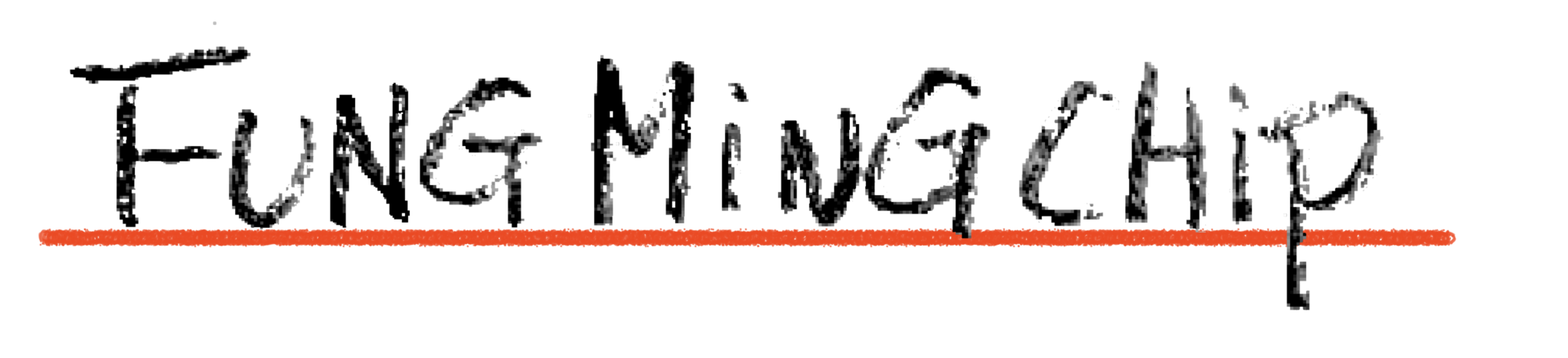
For the past thirty years, Fung Ming Chip has developed and applied an artistic language which draws on wide ranging sources, to explore the roots of the calligraphic image: seal carving, wood carving, ink painting, as well as sculpture and sgraffito.
Since, at the most obvious level, calligraphy is writing, and writing brings meaning, and meaning over time makes narrative, to approach a work by Fung is to be drawn into a textual, visual and intellectual story. The immediate story of these calligraphic texts is personal and contemporary as well as revealing. The visual impact of the story is given ‘simply’ by marks on paper. The intellectual story is dramatic – even revolutionary – and is a vital reflection of the transformation of Chinese art and society as China opens further at the start of the 21st Century.
The fascination and the problem for Western viewers is that the narrative is not easy to understand, unless you can read Chinese. This same problem can be faced by Chinese and other Asian viewers – even artist sometimes has to refer to his carefully kept book of notes, which records the meaning of each of his scrolls and poems in case, at a future time, the spontaneity, creativity and innovation of his art as set down on paper blind his memory to its literal meaning!
In addition to being written works in the ‘Western’ sense, Fung’s art can also be seen as marks or images. Marks as pure gesture detached from style have no place in calligraphy, but they are part of Western art symbolism. And, as marks, calligraphic or tachist paintings have a reasonably long history in ‘Modern’ art. The story of such art in the 20th century is charted through artists such as Paul Klee, Henri Michaux, Franz Kline, Pierre Soulages and Robert Motherwell – with the focus moving from an Orientalist-inspired Europe (primarily the Japanese influence), through American/European Abstraction, to full detachment from the figurative roots of European art.
As images, these works function in both the Chinese and the Western implications of the word. Thus, in the Western sense, one can look at an image created by Fung Ming Chip and feel a sense of calm, without knowing the text is a Buddhist Heart Sutra. One can see in another image a deep swirling sense of mystery. In another again, an anthropomorphic gentleness in the intertwining of two forms. In yet one more, a swirling sense of energy. Some scripts are firm, solid and exude traditional certainties; others wispy and ephemeral.
This overlap between Western and Chinese art forms in the meaning of an image can be seen by juxtaposing the artist’s early works with the works of Juan Miró, or Wassily Kandinsky. It is particularly helpful to compare Fung’s woodcarving, in which he digs into the origins of Chinese script in order truly to understand the sources and inner values of the modern Chinese calligraphic image. The emergence of Chinese writing from primitive pictorial form is part of Fung’s heritage.
In Chinese, the image and the word are not really separate, and in this sense, the Western viewer is at a clear disadvantage to the Chinese when it comes to viewing calligraphy. But, as in the case of narrative, the content is only part of the meaning. In the more deconstructed scripts that Fung Ming Chip has developed, content takes second place to form and the deconstruction of origins. Fung does not have actually to say that he is breaking down all the traditional elements of calligraphy and refusing to use them as tradition would demand – it is as obvious that that is what is happening, as it was obvious that Picasso’s Demoiselles d’Avignon represented a rejection of traditional Western concepts of figurative art and perspective.
This brings us to the third ‘story’ in his works – their quality as an expression of the furthermost intellectual/cultural development of the core of the Chinese art tradition to have been achieved at the beginning of the 21st century.
This is not too radical a claim, and is even a most important question if one believes that it is possible to chart, through the evolution of art, the evolution of societies and cultures, and if one sees, in the work of leading-edge artists, the expression, conscious or not, of the most advanced elements in that social evolution. It also makes him quite different from those artists who have imported and adapted Western ways of expressing modernism – a perfectly valid and often exciting approach, but one which takes place from outside, not within Chinese culture.
So, as a representative of the ‘internal’ in Chinese cultural development, Fung Ming Chip tells us Chinese culture is undergoing a process of intense self-examination, in order to find the best way to adapt its centuries old traditions to the modern world. When others look back on our times, that judgement will, I believe, be confirmed. That is what makes him a significant artist, and not just a fascinating one.
He is in one sense both traditional and Chinese: he has studied deeply the origins and methods of his predecessors: he spent many years researching and carving his own seals, and his woodcarvings clearly derive from ‘primitive’ figure elements – clouds, lightning, eyes, limbs, arrows. His technical exploitation of those most traditional materials – ink and brush on rice paper – makes clear he is in no ‘material’ sense a Western artist.
But in Chinese terms, Fung Ming Chip can also be called subversive, as well as revolutionary, in the following ways:
First, he has decisively broken with the way in which the elements of traditional calligraphy are used. He dis-integrates the connections between strokes or upsets their traditional order and time-values. He lays bare linkages which should remain hidden, so that we can see how layers of ink work, with the first layer dominant, even if the first layer was paler than the later layer. In other words, when he writes in extremely pale ink, or even water on a page, that image will persist even through darker ink painted over it. That is what gives his ‘Light’ script, in particular, its luminosity and depth. This reverses the ‘normal’ experience of oil painting, in which the last stroke overwhelms the first. Literal and metaphoric transparency are a major break with the Chinese past.
The revolutionary quality inherent in his use of calligraphy as an art form can be evoked for Westerners through a literary parallel: James Joyce in ‘Ulysses’ used a recognisable form of the English language, and had the work printed on paper in standard typesetting, and yet because of the ay he used the materials, his work was the essence – even the symbol – of modernity not traditionalism. So it is with Fung.
Second, Fung Ming Chip exploits the emotional content of form, as well as the aesthetic. While ‘Zen’ painters (e.g. Kensai or Huai-su) constitute the only major style to use a vocabulary of form (visual simplicity, direct expression, and purity) which was built into the calligraphic act itself, Fung uses his long-nurtured technical skills in the manipulation of ink to create new scripts in which the line is not always the primary expression of the meaning.
So we see his ‘Light’ calligraphic script emerging from the depths of swirling dark ink. In his ‘Sand’ script, swirling patterns of dried ink blown over water-painted calligraphy bring words to life through the accidental attachment of this or that grain of ink powder to the moistened surface. The ink cannot be ‘drier’ than in these works! We observe in ‘Shadow’ script dramatic oversplashing that, far from obscuring the text of a poem, demonstrates the survival of the word in the face of the power and chaos of the world.
When he uses his extremely pale, almost non-existent inks in ‘Transparent’ script we feel them as a shimmering presence on the surface of the paper, the perfect emotional counterpoint to the ‘letting go’ prescribed by the Buddhist sutras he sets down. And yet his sutras can do the reverse, and shine through the dark ink, illuminated from within by eternal light (‘Light’ script, again). Ming’s calligraphic vocabulary embraces drama, emotion, direct appeal to the heart.
And third, in content, too, Fung Ming Chip breaks decisively with the respectful conventions of the past. “The Story Of Sperm”, “Song Of The Night Walker”, “Post-Marijuana”, “Wave” (i.e. sexual release) – these are titles which demonstrate a use of his art in the expression of uninhibited contemporary experience. And the emotional values of the subject-matter fit the form of calligraphy chosen. Thus, the sperm swims to its destination in a rounded trance-like calligraphy, the night walker walks in rounded, sensual form; post-marijuana speculations float before your eyes; through ‘Form’ script the twinned symbols of spirit and form embrace and merge harmoniously.
There are of course less familiar elements which can generate a resistance in the viewer which needs to be overcome. Colour and its absence, for example. We have become so habituated to the use of colour as a guide to emotion that we feel its absence. But Ming’s use of tones of ink can actually convey colour elements. When the eye has had time to adapt to ink tones, and when the firm blacks, pale creamy greys, greenish mid grays and slate-blue ink strokes in his different works are seen side by side in an exhibition, they bring a subtlety of expression which is all the more appreciated for the initial effort required to read it.
These ink tones are also enhanced by the sharp red forms of the seals he painstakingly carves, which highlight the black or the white of those works which are predominantly at tonal extremes. These seals also create their own patterns and structures, whether used symmetrically (i.e. according to structure of the work), or spontaneously (i.e. essentially according to the spirit of the artist). Finally, the red and the forms help integrate the elements of his works, whether sharply contrasted tonally or not. They may bring a focal point to an ‘empty’ Buddhist sutra, or create a point of merger and exchange between a black and a white area of a painting, or create a line of symmetry between the ideographs of his mirror script.
The effect of all this is to challenge the viewer, especially the Western viewer. Calligraphy is both artistically and literally an unfamiliar language in the Western world. With its strong literary element, it often intimidates the non-Chinese, who may feel an initial awkwardness: they ‘see’ a calligraphic story but do not understand it. But all viewers of his work need to recall the words of Alfred H. Barr, the first Director of MoMA, New York, commenting on the Abstract Expressionists in April 1958: “these painters…do nothing deliberately in their work to make ‘communication’ easy. Yet in spite of their intransigence, their following increases, largely because the paintings themselves have a sensuous, emotional, aesthetic and at times an almost overwhelming mystical power which works and can be overwhelming”. We need to work a little for our rewards.
So the plus side of the difficulty of work which is traditional in outer form but revolutionary in inner spirit, is the pleasure of art that does not shout at you, the novelty of ideas that are precisely not Pop-novel or Shock-novel. (No tired Marilyns; no bisected calves to jolt us into paying attention). We luxuriate in a symbiotic not confrontational relationship between the viewer and the artist – and with the culture of the past… We gain the opportunity to reflect, instead of being spoonfed images so famous that we‘re deprived of the chance to consider reactions which are truly our own.
This is how Fung Ming Chip uses tradition, as Joyce used it, with the joy of artistic subversion. He tells us that something new is happening, historically unique, unavoidable and un-reproduceable: for China will only ‘modernise’ once. As with Western art at previous major junctures, this transition has a ‘never again’ quality. Never again will there be artists so clearly on the cusp of history, reflecting their country’s move from introverted traditionalism to engagement with the world – but for once doing so on terms dictated by China’s own cultural history. With Fung we experience this change at the heart of Chinese culture, expressed by somebody who understands it from the inside, and respects it.
That alone is enough to make Fung Ming Chip a major artist. The sincerity, energy, innovation, and sheer depth of his work make him even more special, whether it is our eyes, our minds, or our hearts that appreciate him.